Choosing the right bowl for your candle sand isn't just about looks. The container you pick affects how cleanly the candle burns, how long the wicks last, and even whether the whole setup is safe. Here's the complete guide to picking sand candle holders and bowls that actually work.
Quick links: Why bowl choice matters · The 3 non-negotiables · Best materials · What to avoid · Sizing your bowl · Multi-wick setups · Matching bowl to use case · Bowls we love at Saga · FAQ · Bottom line
One of the best things about candle sand is that you can put it in almost anything. A glass bowl, a ceramic dish, an old vase, your favourite mug, that handmade pottery piece you brought back from a trip. Pour the granules in, drop a wick in the middle, light it up, and you've got a candle.
But "almost anything" is doing a lot of work in that sentence. Some containers handle a candle flame beautifully and last for years. Others crack on the second burn, scorch the table underneath, or quietly leach wax through their base. The difference isn't always obvious until something goes wrong.
So this is the practical guide to picking a sand candle holder that actually works. We'll cover the rules that genuinely matter, the materials that hold up, the ones that don't, and how to pick a bowl that fits both your home and the way you'll actually use it.
💡 New here? Read our guide to what candle sand is first if you haven't already, it covers the basics of how the product works.

Why bowl choice matters more than you'd think
With a traditional candle, the container comes pre-paired with the wax. The candlemaker has already chosen a vessel that suits the wax volume, fragrance load, and wick size. You just buy it and burn it.
With candle sand, you're the candlemaker. The bowl you choose is half the candle. A wide, shallow bowl gives you a different experience than a narrow, deep vase, even with identical sand and wicks inside. The container's material affects how much heat reaches the surface beneath. Its depth affects how long each wick burns and whether the wax will tunnel. Its shape affects whether multiple wicks can be safely spaced.
None of this is complicated, but most people don't think about it before they buy. A few minutes of consideration up front saves a lot of trial and error later.
The 3 non-negotiables for any sand candle holder
Whatever style of bowl you're drawn to, three things need to be true. If a container fails any of them, look for something else.
1. Heat resistance
This is the big one. Candle sand burns at lower temperatures than a traditional pillar or jar candle, because the flame only ever heats a small melt pool around each wick rather than the entire wax body. But it's still an open flame for hours at a time, and the bowl's base will warm up.
What you want: a material that handles sustained warmth without cracking, warping, leaching, or releasing anything unpleasant. Glass needs to be thick enough not to crack from thermal stress. Ceramic needs to be properly fired and ideally glazed inside. Metal needs to be a real metal, not a coated decorative finish.
2. Adequate depth
The wick needs enough sand around it to burn cleanly and to extinguish itself if the bowl tips. As a rule of thumb, you want at least 2 to 3 cm of candle sand below the base of the wick, and ideally a similar amount around it on all sides. A bowl that's too shallow leaves the wick perched on the surface, with wax pooling outward unevenly and the base of the bowl heating up much faster than it should.
3. A stable, flat base
Sounds obvious, but it's easy to forget when you're falling in love with a piece. A round-bottomed bowl, a vase that wobbles, a vessel that sits on three points instead of a flat ring, any of these makes accidental tipping more likely. Candle sand does typically self-extinguish when a bowl is knocked over (the granules disperse and starve the wick), but you still want stability as your first line of defence, not your last.
Best materials for sand candle bowls
Once heat resistance, depth, and stability are sorted, the choice between materials is mostly about aesthetics, weight, and how the piece feels in your home. Here's what each one brings.
Glass
Glass is the most popular choice and for good reason. It's clean, modern, and lets the candlelight pass through the granules in a way no other material can match. White candle sand in clear glass looks especially striking when lit at night.
The catch is that not all glass is candle-safe. You want thick-walled, tempered, or borosilicate glass, the kind made for ovenware or laboratory use. Thin decorative glass, vintage finds with unknown origins, and most drinking glasses can crack from sustained heat. If you can't see the wall thickness clearly, treat it with caution.
Mason jars, hurricane vases, and purpose-made candle vessels are all reliable choices. Cylindrical glass cylinders are particularly popular for floating candle setups, since they let you see the water level beneath the floating sand layer.
Ceramic
Ceramic is the most forgiving material for candle sand. Fully glazed, kiln-fired ceramic handles heat beautifully, doesn't conduct it strongly to the surface beneath, and gives you almost limitless aesthetic options: matte, glossy, textured, hand-thrown, mass-produced, every colour you can imagine.
Look for ceramic that's labelled microwave-safe or oven-safe, or that explicitly says it's intended for candle use. The interior should be smooth and glazed, not raw clay. Unsealed ceramic can absorb fragrance oils over time and become discoloured.
This is the material we've leaned into for our own bowl collection. The look is timeless, the safety profile is excellent, and the weight gives the candle real presence on a table.
Metal
Stainless steel, tin, and brass all work. Metal is durable, lightweight, and gives a more modern or industrial look depending on the finish. The trade-off is that metal conducts heat, so the base of a metal bowl will get noticeably warm during a long burn. Always place it on a coaster or trivet, never directly on a delicate surface.
Avoid metal containers with non-stick coatings, decorative paint inside, or visible seams that could leak. Solid, seamless metal vessels are what you want.
Stone, concrete, and stoneware
These materials look fantastic and handle heat well, but they're porous unless properly sealed. Concrete in particular needs an interior seal compatible with wax, otherwise it will absorb fragrance oils and discolour over time. If you're buying a stone or concrete bowl specifically for candle use, check that the maker has sealed the interior. If you're repurposing a planter or decorative piece, a coat of food-safe sealant on the inside before first use is a good idea.
BLOOM Candle Bowl
View product +
What to avoid (and why)
A few materials and shapes look tempting but don't hold up well, and a couple are genuinely unsafe.
- Plastic. Even plastics labelled heat-resistant can warp, soften, or release compounds when exposed to a candle flame for hours. Don't use them.
- Wood (raw or untreated). Wooden dough bowls and rustic wooden vessels are popular for trad candle aesthetics, but they're flammable and can absorb wax and act as a giant secondary wick. If you use a wooden vessel, line it with a heat-safe glass or metal insert. Never burn directly on raw wood.
- Unsealed terracotta or rough clay. These are porous enough to absorb wax and fragrance oils, which can cause leaching and unpredictable burn behaviour.
- Thin or vintage decorative glass. Pretty thrift finds and delicate antique glassware are usually made with annealed glass that cracks under thermal stress. Save them for flowers.
- Anything narrower at the top than the bottom. Vases that taper inward at the rim trap heat near the wick. The wick can struggle for airflow, soot heavily, and the top of the vessel can heat dangerously.
- Containers smaller than about 8 cm wide. A wick needs enough surrounding sand to burn cleanly. Very narrow containers force the wick too close to the wall and can cause the vessel to overheat.

Sizing your bowl: how big is the right size?
For a single-wick setup, almost any bowl between roughly 8 cm and 20 cm wide will work. Below 8 cm and you're crowding the wick. Above 20 cm with only one wick and the candle starts to look lonely, with most of the surface unlit and unused.
The key dimension is actually depth, not width. You want at least 4 to 5 cm of internal depth so you can pour enough sand for both burn time and self-extinguishing safety. Shallow saucers and dinner plates don't work well, even if they look like they should.
For burn time, the rule is simple: more sand equals more total burn time, because you can keep replacing wicks as long as you have wax. A small 10 cm bowl filled to a 4 cm depth holds enough candle sand for many evenings. A larger 18 to 20 cm bowl can hold enough for months of regular use. Pick the size that suits how often you'll burn it and how visible you want it on the surface it sits on.
Multi-wick setups and the 8 cm rule
Multi-wick candle sand bowls are stunning. Three or four flames spread across a wide surface throws far more light than a single wick, and the visual is hard to beat for dinner parties or as a coffee table centrepiece.
One rule matters above all others here: keep at least 8 cm of distance between every wick. This is because each lit wick creates its own small melt pool around itself. If two wicks are too close, their melt pools merge, the wax overheats, and the burn becomes uneven and potentially unsafe.
Practical implications:
- A bowl that's 16 cm wide can comfortably hold two wicks with proper spacing.
- A 24 cm bowl can hold three.
- A 30+ cm bowl or shallow tray can hold four or more, depending on layout.
- For round bowls, place wicks in a triangle or diamond pattern rather than a straight line, so each wick has 8 cm of clearance from every neighbour.
Width matters more than depth here, since the wicks need horizontal space to breathe. A wide, shallow bowl is actually ideal for multi-wick setups, as long as it still meets the 4 to 5 cm depth minimum.

Matching bowl shape to how you'll use it
Different shapes suit different jobs. A few patterns we've noticed working well:
Coffee table or dining centrepiece
Wide and shallow. Round or oval, around 20 to 30 cm in diameter, 5 to 8 cm deep. Multi-wick setup with three or four flames. This is the showstopper format, the one that gets photographed and asked about.
Bedside or reading nook
Smaller and more contained. A single-wick bowl around 10 to 12 cm wide, in a calm matte ceramic finish. The light is intimate, the footprint is small, and the bowl fits comfortably on a nightstand without dominating it.
Bathroom or spa setup
Glass works particularly well here, ideally with white candle sand. The reflective surface plays beautifully with bathroom tile and tap fittings. Shallow round bowls around 12 to 15 cm wide are easy to place on a bath caddy or vanity.
Outdoor dining or terrace
Heavier ceramic or stoneware. The weight matters, since outdoor surfaces can be uneven and breezes are a factor. Avoid metal in direct sunlight, since it can heat up dramatically before you even light the wick. Always shelter from wind, since gusts make wicks burn unevenly.
Floating candle display
Wide, shallow, transparent glass. Cylinder vases or low glass bowls work best. White candle sand floats on water (colored versions typically don't), so this is one of the few setups where the bowl material is genuinely critical: you need to see the water beneath the floating sand layer for the effect to work.
Bowls we love at Saga
If you'd rather skip the search and start with a bowl designed specifically for candle sand from the ground up, that's exactly what we make. Every bowl in our collection is glazed ceramic, properly proportioned for candle sand, deep enough for safe burns, and balanced for stability on any flat surface. The shapes are designed for both single and multi-wick setups, and the finishes are chosen to suit modern, minimalist, and natural interiors.
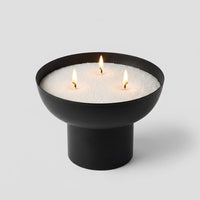
Our flagship piece is the Bloom bowl, a wide, low-profile ceramic in either matte black or warm beige, designed for two- or three-wick setups and ideal as a coffee table or dining centrepiece.
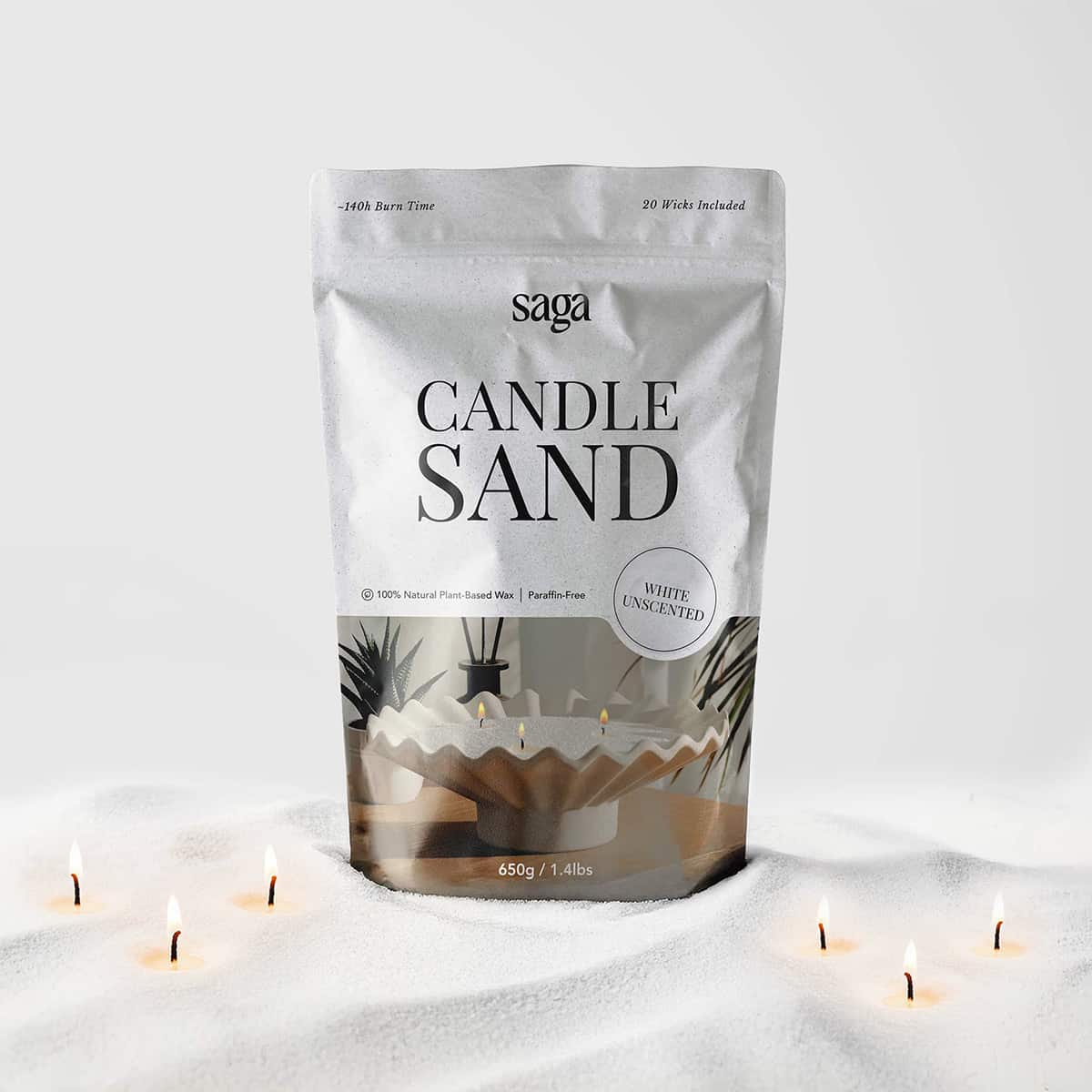
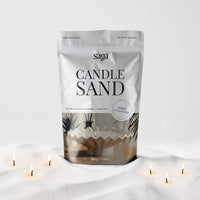
For a complete look, you can pair any of our bowls with our candle sand and accessories.
Saga Candle Sand
View product +
Or browse the full bowl collection to see all the shapes and finishes available.
Common questions about sand candle holders
Can I use a regular bowl from my kitchen for candle sand?
Often yes, with caveats. If the bowl is glazed ceramic, oven-safe, and at least 4 cm deep with a flat stable base, it will probably work fine. Mason jars and pyrex glassware are also reliable. Avoid thin glassware, anything plastic, anything with a metallic decorative finish, and any vessel with a narrow rim. When in doubt, do a test burn for an hour before committing to a longer one, and check that the base of the bowl isn't getting hot enough to mark the surface beneath.
How deep should the candle sand layer be?
Aim for at least 2 to 3 cm of sand below the wick base, and a similar amount around it. For multi-wick setups in larger bowls, 3 to 4 cm is a good target. The deeper the sand, the more burn time you get and the more reliably the candle self-extinguishes if knocked over.
Can I use a vintage bowl I love?
Possibly, but inspect carefully. Look for hairline cracks (a death sentence for any candle vessel), unglazed interior surfaces (porous and risky), and unstable bases. If the bowl has been used for food and looks intact, it's usually a reasonable candidate. If it's purely decorative or you don't know its history, lean cautious. A test burn at low duration is always smart with anything you're unsure about.
Do I need a special candle holder for candle sand, or will any container do?
Any heat-resistant container that meets the three non-negotiables (heat resistance, depth, stable base) will work. There's no special "candle sand holder" technology required. That said, bowls designed specifically for candle sand are usually proportioned for the way the product actually burns, with the right depth and width relationship for clean multi-wick setups, which a random kitchen bowl may or may not get right.
How do I clean a candle sand bowl between uses?
You usually don't need to clean it during the candle's life. When a wick burns down, you just remove the spent wick, level the sand surface gently, and insert a fresh wick. When you eventually empty the bowl entirely (after using up the sand or wanting to switch scents), let any residual wax cool fully, then wash with warm water and dish soap. Avoid abrasive scrubbers on glazed ceramic.
What's the maximum size bowl I can use?
There's no real upper limit, as long as you respect the 8 cm wick spacing rule and use enough wicks to actually light the surface. A 40 cm tray with seven wicks is a striking event piece. A 60 cm shallow vessel with nine or ten wicks is dramatic for weddings. The constraint is just having enough sand to fill the bowl to proper depth and enough wicks to use it all. Browse our accessories collection for extra wicks and tools if you're scaling up.
A note on safety
Disclaimer: Whatever bowl you pick, follow basic candle safety. Never leave a burning candle unattended. Keep flames out of reach of children and pets. Place the bowl on a heat-safe surface, away from anything flammable, and never burn near curtains or in a draft. Candle sand significantly reduces certain candle-fire risks because the flame typically self-extinguishes when the bowl tips, but it doesn't eliminate the need for normal candle care.
Bottom line
The right sand candle holder isn't about luxury or expense. It's about a few simple criteria: heat resistance, enough depth to burn safely, a stable base, and proportions that suit how you'll use it. Glass, glazed ceramic, and solid metal are all reliable choices. Plastic, raw wood, unsealed porous materials, and thin decorative glass are not.
If you've got a bowl in your home that meets the criteria, use it. That's part of the appeal of candle sand: the same bag of granules can become a centrepiece in a vintage glass dish, a bedside light in a handmade ceramic, or a wedding tablescape in a sweep of matching bowls. The container is yours to pick.
Once you've picked your bowl, our beginner's guide to using candle sand walks through the rest: setup, multi-wick spacing, scenting, and troubleshooting.
Ready to build your candle sand setup? Browse Saga Candle Sand →