The honest answer to whether scented candles are harmful, what the research actually shows, and how plant-based candle sand changes the equation.
Quick links: The honest short answer · What the research says · The real issues · What candle sand does differently · Safety with kids and pets · What to look for · FAQs · Bottom line
You light a scented candle, breathe in something cozy, and somewhere in the back of your mind a half-remembered headline floats up. Aren't these things supposed to be bad for you?
It's a fair question. There's been enough viral coverage to make any reasonable person pause, from indoor air quality studies to the occasional alarmist headline claiming your favorite candle is "as bad as smoking" (it isn't, but we'll get to that).
Here's the honest answer, from a candle maker. Some scented candles are genuinely problematic. Most are fine. The differences come down to four things: the wax, the fragrance certification, the wick, and how you burn them. This article walks through what the research actually shows and how to pick options that won't fill your home with stuff you don't want to breathe.
Quick answer: Most scented candles aren't an acute health risk when burned occasionally in a well-ventilated room. The real problems show up with paraffin-based candles using synthetic, uncertified fragrance oils burned heavily in small enclosed spaces. Plant-based candles with IFRA-certified fragrance oils, like Saga candle sand, release significantly fewer combustion byproducts and use fragrance compounds restricted to international safety standards. The wax base and the fragrance certification matter far more than the brand on the label.
💡 New to Candle Sand? Read our article on what is candle sand first for the basics on how this category works.

The honest short answer
The blanket statement "scented candles are bad for you" is too sweeping to be useful. The honest answer has nuance, and the nuance matters.
For most people, in most homes, lighting a scented candle for a few hours in a ventilated room isn't going to do measurable harm. The headlines comparing candles to cigarettes typically rely on extreme test conditions (sealed chambers, continuous burn, no ventilation) that don't reflect how anyone actually burns a candle in real life.
That said, "not acutely dangerous" is not the same as "completely fine." Burning anything releases combustion byproducts. The questions worth asking are which byproducts, in what quantities, and whether anyone in your household has reasons to be more cautious than average. People with asthma, infants, indoor pets, and anyone living in small unventilated spaces have a legitimate case for being more selective about which candles they burn.
The good news is that the variables determining candle safety are largely things you can see on a label, if you know what to look for.
What the research actually says
If you cut through the viral health blogs and look at what mainstream medical sources actually publish, the picture is calmer than the headlines suggest.
Cleveland Clinic's published position on candles is roughly this: scented candles are not a major health concern for most people, but you should ventilate well, choose plant-based waxes when possible, and avoid burning them around people with respiratory sensitivities. Their guidance is about smart use, not abstinence.
Peer-reviewed studies indexed in the US National Library of Medicine's PMC archive do show that paraffin-based candles release measurable amounts of volatile organic compounds (VOCs) when burned. These can include small quantities of benzene, toluene, formaldehyde, and acetaldehyde. The same studies generally find that plant-based waxes (soy, beeswax, vegetable-derived) emit lower levels of these compounds during normal combustion. None of the credible research concludes that occasional candle use poses an acute health risk for the average person in a normal home environment.
Where research does flag concern is in three specific scenarios. Heavy daily use of paraffin candles in small unventilated rooms. Use around people with diagnosed respiratory conditions like asthma. And exposure of household pets, particularly cats and birds, whose respiratory and metabolic systems are more sensitive than ours.
So the research doesn't say candles are dangerous. It says that the type of candle, the burning conditions, and who's in the room all change the risk profile. That's actionable information.
The real issues with scented candles
When scented candles do cause problems, the issues almost always trace back to one of four things.
1. Paraffin wax combustion
Paraffin is a byproduct of petroleum refining. When it burns, it releases combustion byproducts that include small amounts of benzene, toluene, formaldehyde, and acetaldehyde. The levels in a typical home are below what regulatory bodies consider acutely harmful, but they're not zero. Over years of heavy use in a poorly ventilated space, the cumulative load matters.
Paraffin candles also tend to produce more visible soot, particularly when the wick is too long or the flame is in a draft. That soot deposits on walls, ceilings, and yes, lungs.
2. Synthetic fragrance with no certification
The word "fragrance" on a candle label can hide a long list of compounds, because under most regulatory regimes manufacturers don't have to disclose what's actually in the fragrance blend. Some of those compounds, particularly certain phthalates used as fragrance fixatives, have been flagged as endocrine disruptors and are restricted in the EU and increasingly in the US.
The International Fragrance Association (IFRA) maintains a list of restricted and prohibited compounds based on independent safety research. Fragrance oils that carry IFRA certification have been formulated to comply with these international standards. Fragrance oils without that certification might be perfectly fine, or might contain compounds that wouldn't pass. With no disclosure requirement, you can't tell from the label.
3. Fragrance load percentage
Fragrance load is the percentage of the candle's weight made up of fragrance oil. Most commercial scented candles run between 6% and 12% fragrance load by weight. Higher loads produce stronger scent throw, which is what many buyers think they want, but also more compounds released during combustion.
The candles that get flagged in air-quality studies tend to be the heavily scented ones, where the manufacturer pushed the load to maximize "throw" without much thought about combustion chemistry. A candle that fills a whole house with scent in fifteen minutes is also filling that house with whatever the fragrance contained.
4. Low-quality wicks
Lead-cored wicks were banned in the US in 2003 and were never widely used in Europe, but cheap candles can still come with low-quality wicks that produce excess soot or burn unevenly. Cotton or paper wicks are the safe baseline. Anything described as "metal-cored" should be inspected. The metal itself isn't necessarily a problem if it's zinc, but quality control on bargain-tier candles is unreliable.

What plant-based candle sand does differently
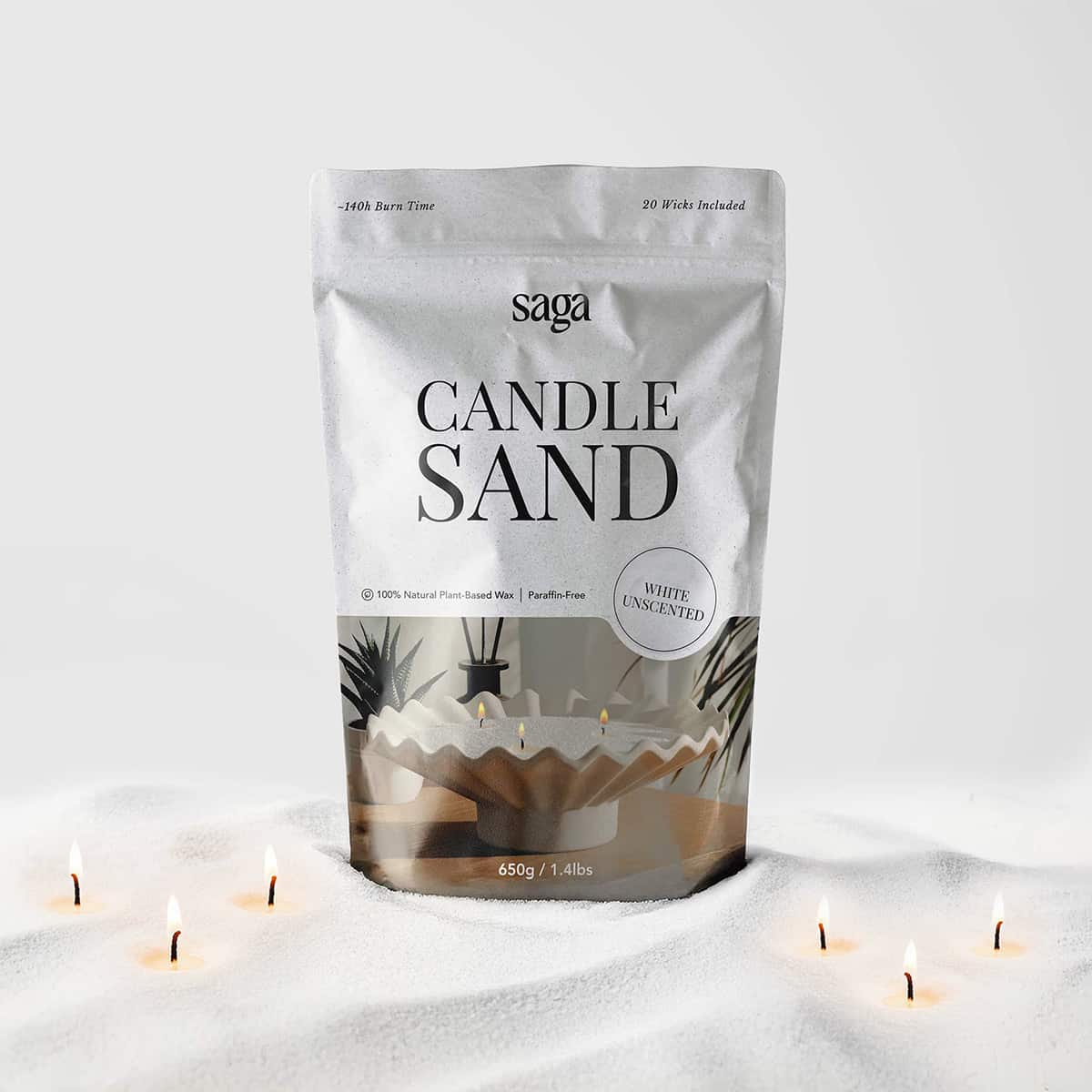
Candle sand is a granular wax format. Instead of pouring molten wax into a container, you scoop small wax pearls into any heat-resistant vessel, push in a cotton wick, and light it. The wick burns, the surrounding wax melts to feed the flame, and when you're done you blow out the wick. The wax goes solid again and resets.
That format changes a few things relevant to this article.
Saga candle sand is made from 100% plant-based vegetable wax. No paraffin, no petroleum derivatives, no soy. The combustion profile is closer to beeswax than to paraffin, with significantly lower benzene and formaldehyde emissions in independent testing of comparable plant-wax candles.
Saga's scented variants use a 6% fragrance load, on the lower end of the typical 6% to 12% range for commercial scented candles. The scent is noticeable but not overwhelming, and the fragrance compound load entering the air is correspondingly lower. All Saga scents use IFRA-certified fragrance oils, meaning the compounds comply with the International Fragrance Association's restrictions on phthalates, sensitizers, and known problem chemicals.
The unscented options (available in white, black, wine red, sky blue, and emerald green) contain no added fragrance at all and burn essentially as cleanly as a plant-wax candle can. The wicks are 100% cotton, no metal core, no synthetic additives, and each one burns for around 12 hours.
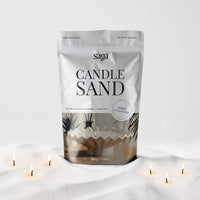
Saga Candle Sand
View product +
Are scented candles safe in households with kids and pets?
This is one of the most common questions we get, and it deserves a direct answer.
For most households with children or pets, plant-based candles using IFRA-certified fragrance oils are safe to use with normal precautions. The category to be more cautious about is heavily scented paraffin candles, especially in small rooms or anywhere a child or pet might tip them over.
For infants and very young children, the main concerns aren't actually the fragrance compounds (which are present at low concentrations in a ventilated room) but the open flame, the hot wax, and the tip-over risk. Granular wax addresses the third issue meaningfully: when a candle sand setup is tipped, the wax pearls disperse rather than pouring as a single hot liquid mass, and the flame typically extinguishes as the bed of pearls separates from the wick.
For dogs, the concerns are similar to humans but scaled to body size and respiratory rate. Lower-quality scented candles can trigger sensitivity in dogs the same way they can in asthma-prone humans. Plant-wax candles with certified fragrance reduce that risk substantially.
Cats are the trickiest case. Cats have liver enzyme limitations that make them less able to metabolize certain compounds, including some essential oils (tea tree, eucalyptus, citrus, cinnamon, and peppermint) and some synthetic fragrance compounds. If you have a cat, avoid candles disclosing essential oils on the cat-toxic list, keep the cat out of the room during burn, and ventilate the space afterwards. Plant-wax candles with IFRA-certified fragrance are a meaningful upgrade over paraffin alternatives, but no candle is "cat-proof."
For the full breakdown on candles in homes with pets, see our dedicated article on pet safe candles.
Disclaimer: We're candle makers, not veterinarians or physicians. If anyone in your household has asthma, severe allergies, or chronic respiratory conditions, or if a pet shows signs of irritation around any candle, consult a qualified professional before continuing use.
What to look for (and what to avoid)
If you've made it this far, here's the practical buyer's checklist.
Green flags on a candle label:
- Plant-based wax disclosed by name. "Vegetable wax," "soy wax," "beeswax," or "coconut wax." Vague descriptors like "natural wax blend" without specifics often hide paraffin.
- IFRA-certified or fragrance disclosure. Brands willing to disclose that their fragrance oils meet IFRA standards are signaling effort and accountability.
- Cotton or paper wicks specified. Bonus points for an explicit "lead-free" callout.
- Reasonable fragrance load. Anything described as "lightly scented" or in the 6% to 8% range is sensible. "Maximum scent throw" usually signals a heavy fragrance load.
- Transparent ingredient list. A brand willing to publish what's actually in their candle has nothing to hide.
Red flags on a candle label:
- "Paraffin wax" or unspecified wax. If the wax isn't clearly identified as plant-based, assume it's paraffin or a paraffin blend.
- "Fragrance" with no source disclosure. Hidden fragrance blends are the single largest variable in candle safety.
- Mass-market bargain pricing. Quality candle making costs money. Three-dollar scented candles in a discount aisle are almost always paraffin with cheap synthetic fragrance.
- Heavy black soot during burn. Soot is a sign of incomplete combustion, usually from paraffin wax or a wick too large for the wax type.
- Overwhelming scent that fills a house in minutes. That's a high fragrance load doing exactly what it was formulated to do, and it's putting more compounds into your air than a milder candle would.

Frequently asked questions
Are paraffin candles really dangerous?
Not in the sense of acute danger from occasional use in a ventilated room. Paraffin candles do release more combustion byproducts than plant-based alternatives, including measurable but small amounts of benzene, toluene, and formaldehyde. If you burn paraffin candles heavily in small unventilated spaces, the cumulative exposure matters more. The better question isn't whether paraffin is dangerous but whether it's the best available option, and the answer there is no.
What does IFRA-certified actually mean?
The International Fragrance Association (IFRA) is the global self-regulatory body for the fragrance industry. It maintains a list of restricted and prohibited compounds based on independent safety research. An "IFRA-certified" fragrance oil has been formulated to meet IFRA standards: it doesn't contain phthalates above the restricted level, doesn't include known sensitizers above safe thresholds, and complies with international (EU, US, UK) consumer safety expectations.
Are scented candles safe for people with asthma?
It depends on the candle and the person. Many people with mild asthma tolerate plant-wax candles with certified fragrance without issue. People with moderate to severe asthma should be more cautious, particularly with heavily scented paraffin candles in small rooms. Test cautiously in a ventilated space, watch for symptoms, and switch to unscented plant-wax candles if a reaction shows up.
Are scented candles safe around babies and toddlers?
The main risks to small children from candles are the flame, the hot wax, and the tip-over hazard rather than the fragrance compounds. Keep candles out of reach, never leave them unattended, and consider granular wax formats like candle sand, which behave more forgivingly if knocked over because the pearls disperse rather than pouring as hot liquid. For fragrance specifically, plant-based candles with IFRA-certified scents are the sensible choice.
Are scented candles safe for dogs and cats?
For dogs, plant-wax candles with certified fragrance are generally well tolerated with normal ventilation. For cats, more care is warranted. Cats have liver enzyme limitations making them less able to process certain compounds, particularly some essential oils. Avoid candles disclosing essential oils on the cat-toxic list (tea tree, eucalyptus, citrus, cinnamon, and peppermint), keep the cat out of the room during burn, and ventilate afterwards.
Which candles are the safest to buy?
The safest category is unscented plant-wax candles with cotton wicks, burned occasionally in a ventilated room. The next safest is scented plant-wax candles using IFRA-certified fragrance oils at a moderate 6% to 8% fragrance load. Saga candle sand fits both categories: the unscented colored variants are the lowest-emission option, and the IFRA-certified scented variants are close behind.
The bottom line
Scented candles aren't categorically bad for you. The category contains everything from bargain paraffin with hidden fragrance blends to small-batch plant-wax candles using internationally certified scent compounds. The differences in what they put into your home's air are significant.
If you want the cozy ambiance without the air-quality concerns, the answer is to pay attention to four things: plant-based wax, IFRA-certified fragrance, cotton wicks, and a reasonable burn schedule in a ventilated room. Saga's full range of candle sand sits in that category by design, and if you're ready to pick a scent, our guide on how to choose your scented candle sand walks through the four Saga blends and when each one fits.
The broader truth is that "is X bad for you" is almost never a yes-or-no question. The honest answer is usually: it depends on which X, how it's made, how you use it, and who's in the room. Scented candles are no different. Choose well, burn responsibly, and the cozy is worth it.
Ready to try a cleaner scented candle? Browse the full range at Saga's candle sand collection, or learn more about the brand at sagacandles.com.