How scent actually works in candle sand, how the four Saga scents differ, when to mix your own using essential oils, and how to pick the right one for your room and mood.
Quick links: What is scented candle sand · How scent works in candle sand · The four Saga scents · Unscented + essential oils · Practical tips · FAQs
Buying scented candle sand should be the fun part. Then you actually try to pick one.
Lush Lemongrass sounds nice, but is it kitchen-nice or living-room-nice? Rhubarb Fizz is intriguing, but you've never actually thought of rhubarb as a candle before. Spicy Pomegranate either sounds great or like trying too hard, and you can't quite decide which. And what does Gold Coast even smell like? Holiday cocktail? Sunscreen? Both?
Good news: there are really only two questions you need to answer to pick the right one. What mood are you going for, and what room is the candle going in? Once you understand how scented candle sand actually works (it's genuinely different from a poured wax candle), the rest gets a lot easier.
💡 New to candle sand? Start with our guide on what is candle sand, then come back here when you're ready to choose a scent.

What is scented candle sand?
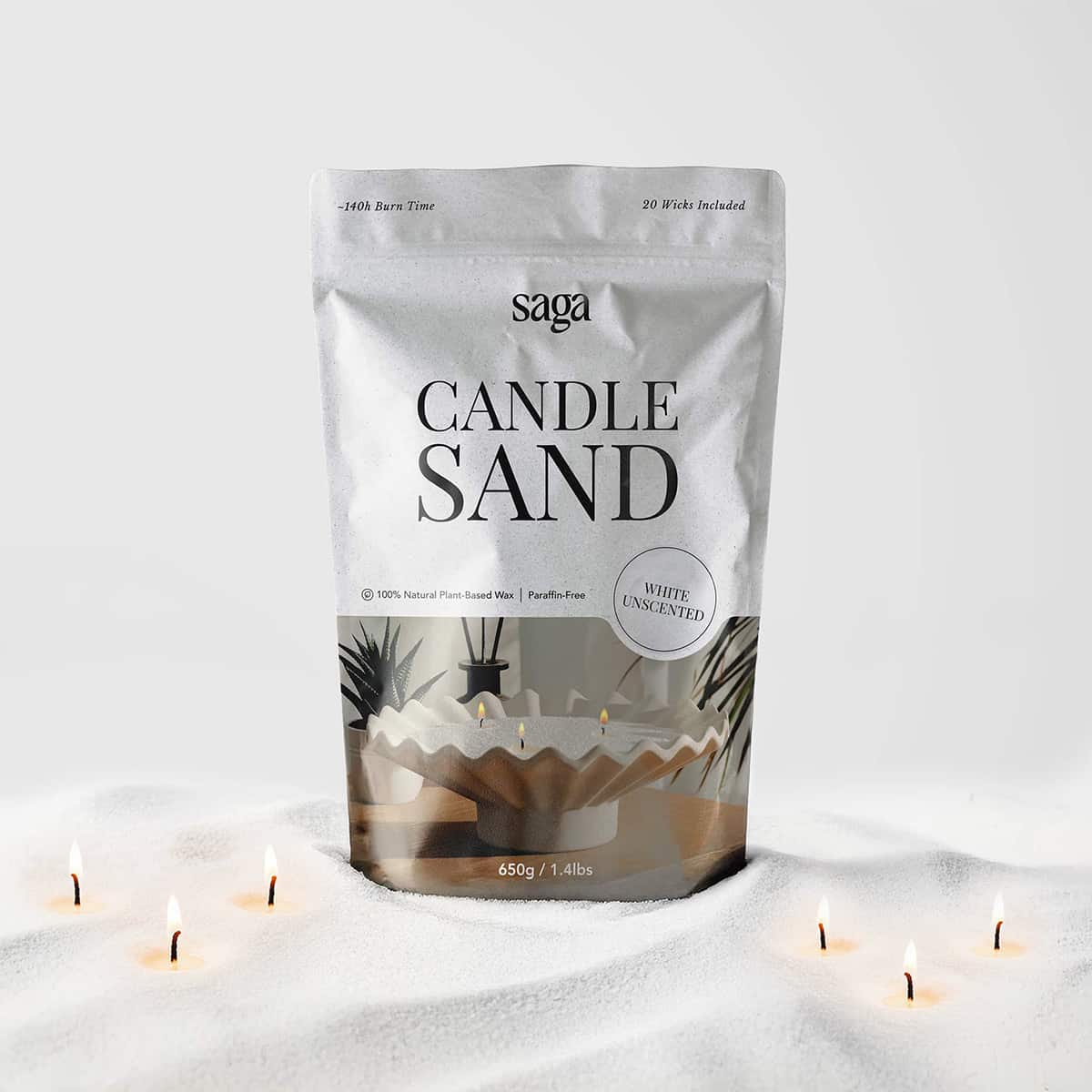
Scented candle sand is plant-based granular wax that has fragrance oil blended into it during production. You pour it into any heat-safe container, insert a wick, and light it the same way you would unscented candle sand. The fragrance releases as the wax around each wick slowly melts.
The key distinction is between two formats:
- Pre-scented candle sand: Fragrance is baked into the wax granules at the manufacturing stage. You don't add anything. Just pour, wick, light.
- Unscented candle sand + essential oils: You buy unscented sand (white or colored), pour it, and add a few drops of your own essential oil or fragrance oil around each wick. You control the scent and intensity.
Both approaches have their place, and most people end up using both depending on the occasion. We'll cover the DIY route in detail further down.
Saga offers pre-scented candle sand in four signature blends, all in our white wax base. The colored variants (black, emerald green, wine red, sky blue) are unscented by design, leaving you free to scent them with whatever you like.
How scent actually works in candle sand
This is the part most product pages skip, and it's the part that explains every other decision you'll make.
Granular waxes carry less fragrance load than poured candles. A traditional soy candle can hold roughly 10% fragrance oil by weight. Candle sand typically caps closer to 6%. That's not a flaw, it's a physical reality of how the granules absorb and release oils through their surface area.
What this means in practice:
- Scent throw is softer. A high-quality scented candle sand will perfume a small or medium room beautifully, but it won't dominate an open-plan living area the way a heavily fragranced jar candle might.
- The fragrance is cleaner. Less oil means less smoke, less soot, and a much lower chance of getting that headachy, over-perfumed feeling halfway through the burn.
- You can interchange scents. Because the wick (not the wax itself) is what carries the flame, you can extinguish, swap containers, or refresh between burns in ways you simply cannot with a poured candle.
If you're weighing scented candles in general against your home's air quality, our companion article on are scented candles bad for you walks through what the research actually shows about plant-based wax versus paraffin, IFRA-certified fragrance, and what to look for on a label.
The trade-off is intentional. Scented candle sand is built for ambient, layered scent rather than for filling a whole house from one wick. Pair it with the right room and the right moment, and it's quietly perfect.

The four Saga scents and when to use each
Saga's scent range is deliberately small. Four blends, each formulated with IFRA-certified fragrance oils, each meant to do one mood very well rather than try to be everything. Here's how to read them.
Spicy Pomegranate
The most sophisticated of the four. Juicy pomegranate and plum meet warm spices, cedar, and a hint of leather. It reads as adult, evening, and just a touch unexpected.
Best for: Dinner parties, autumn and winter evenings, dining rooms, libraries or studies. If you like the idea of a candle that smells like a good cocktail bar in a hotel you'd actually want to stay in, this is the one.
Lush Lemongrass
Citrus with backbone. Fresh lemongrass leads, then warms into ginger and nutmeg, grounded by earthy cedar. It's bright without being soapy and herbal without being aggressive.
Best for: Kitchens, bathrooms, morning routines, work-from-home spaces. Lemongrass has a long tradition in calming and focusing rituals, and this version sits beautifully in any room where you want clarity instead of cozy.
Rhubarb Fizz
Romantic and playful. Champagne effervescence meets tart rhubarb, sweet peach, and wild berries. It's not a typical floral or a typical fruity, it's somewhere in between, like an aperitif you'd serve on a summer evening.
Best for: Brunches, bridal events, spring and early summer styling, bedrooms. Reads especially well in a room with lots of natural light.
Gold Coast
A tropical escape in scent form. Sun-ripened mango and zesty lime layered with pineapple and a touch of vanilla sugar. Surprisingly versatile despite the holiday-vibe name.
Best for: Summer entertaining, beach-themed events, outdoor table settings (in a heat-safe container, with the candle attended), and anyone who wants a candle that smells like a vacation without smelling artificial.
One thing worth knowing: because candle sand can be split across multiple containers, you can run two scents in different rooms from a single purchase. A bowl of Lush Lemongrass in the kitchen and Spicy Pomegranate in the dining room creates a layered, restaurant-quality experience that's almost impossible to achieve with traditional candles.
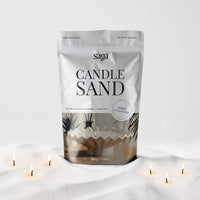
Saga Candle Sand
View product +
Unscented candle sand + essential oils: the DIY option
If none of the four scents speak to you, or if you want full control over what your home smells like, the DIY route is worth knowing about.
Saga's colored candle sand (black, emerald green, wine red, sky blue) and the unscented white variant are all designed to take added fragrance. The technique is straightforward:
- Pour your unscented candle sand into a heat-safe container.
- Insert your wicks (keep at least 8cm between wicks for multi-wick setups).
- Add 4 to 6 drops of essential oil or candle-grade fragrance oil around the base of each wick.
- Light as usual.
You can refresh the scent each time you relight. You can blend two oils together (lavender + cedarwood is a classic). You can match the scent to a season, a mood, or a particular evening. It's the closest thing to a scent diffuser that still gives you the flame.
A note on oil choice: essential oils made for skincare aren't always the best fit for combustion. Look for oils labeled candle-grade or fragrance oils made for diffusers and candle making. They throw better and burn more cleanly.

Disclaimer: We're candle makers, not aromatherapists. If you're pregnant, have allergies, or have pets sensitive to specific essential oils, check with a qualified professional before using them around the home.
Practical tips for choosing and using scented candle sand
Match the scent to the room size
Because candle sand throws softly, the size of the container and the number of wicks matter more than usual. A single-wick bowl is perfect for a bedside table or a bathroom. A multi-wick setup in a wide, shallow vessel will scent an open living area noticeably better. If you're trying to fragrance a large room, use two or three smaller bowls placed strategically rather than one huge one.
For container ideas, see our guide on sand candle holders and bowls.
Pair scents with the season
Scent perception shifts with temperature and humidity. Bright, citrus, and tropical scents (Lush Lemongrass, Gold Coast) feel more natural in warm months. Deeper, spicier scents (Spicy Pomegranate) come alive when the temperature drops. Rhubarb Fizz bridges seasons well and works almost year-round.
Refresh, don't replace
If a scent feels faded after several burns, the fix is usually a wick change rather than new sand. Each cotton wick burns for about 12 hours. A fresh wick reopens the surface of the wax and releases new fragrance from the granules around it. You can also gently stir the sand between burns to redistribute the unburned wax to the top.
Don't mix two strong scents in the same room
Layering scents across rooms is wonderful. Stacking two strong scents in the same room usually muddies both. If you want to layer in one space, choose one dominant scent and let a much subtler second scent (or unscented sand with a light essential oil) play in the background.
Always follow basic candle safety
Even though candle sand typically self-extinguishes if the container tips over, the flame is still a flame. Never leave a burning candle unattended. Keep it out of direct reach of children and pets. Use heat-safe containers only.
Frequently asked questions
How long does the scent in scented candle sand last?
With proper use (replacing wicks as they burn down, stirring the sand occasionally), a single batch of scented candle sand will continue releasing fragrance until the wax is fully spent. For Saga's white scented sand, that's typically dozens of hours of cumulative burn time per package.
Can you add essential oils to already-scented candle sand?
You can, but it's usually not a great idea. Combining two scent profiles often creates muddled, unpredictable results. Stick to one or the other. If you want to experiment with custom blends, start with unscented sand.
Is scented candle sand safe for homes with pets?
Scented candle sand made with plant-based wax and IFRA-certified fragrance oils is generally a much more forgiving option than paraffin-based scented candles, which release more soot and combustion byproducts. That said, certain essential oils (tea tree, eucalyptus, citrus oils in some cases) can be problematic for cats and birds. If you have pets with sensitivities, the pre-scented Saga blends or a vet-cleared essential oil are safer paths than picking oils at random. Our full guide on pet-safe candles goes deeper on this.
Why does scented candle sand smell softer than a regular candle?
Granular wax holds about 6% fragrance load by weight, compared to roughly 10% in a poured soy candle. The softer throw is a feature, not a defect. It creates ambient scent rather than overwhelming a room, and it produces less soot and fewer combustion byproducts in the process.
Can scented candle sand be used for floating candles?
Saga's white candle sand floats on water, which makes it suitable for floating candle displays. The scented white sand can be used the same way. Colored variants (black, emerald green, wine red, sky blue) typically do not float and shouldn't be used in water-based setups.
What's the difference between scented candle sand and a scented wax melt?
Scented wax melts are warmed by an external heat source and never burn directly. Scented candle sand has its own wick and produces a real flame, which means it generates ambient warmth and visual light alongside the scent. Wax melts throw more aggressive scent because they don't compete with combustion, but they lack the candlelight.
The bottom line
Picking a scent isn't really about scent. It's about matching a mood to a room to a moment. Saga's four scents each do one mood especially well: Spicy Pomegranate for sophisticated evenings, Lush Lemongrass for clarity and focus, Rhubarb Fizz for celebration, Gold Coast for warmth and escape. If none of those match what you want, the unscented colored variants plus your favorite essential oil will get you exactly where you want to go.
Either way, the underlying product is the same: 100% plant-based granular wax, cotton wicks, IFRA-certified fragrance (when scented), and the freedom to use it in almost any heat-safe container you already own.
Browse the full Saga candle sand collection to see every scent and color, or visit our homepage to learn more about how Saga is made.